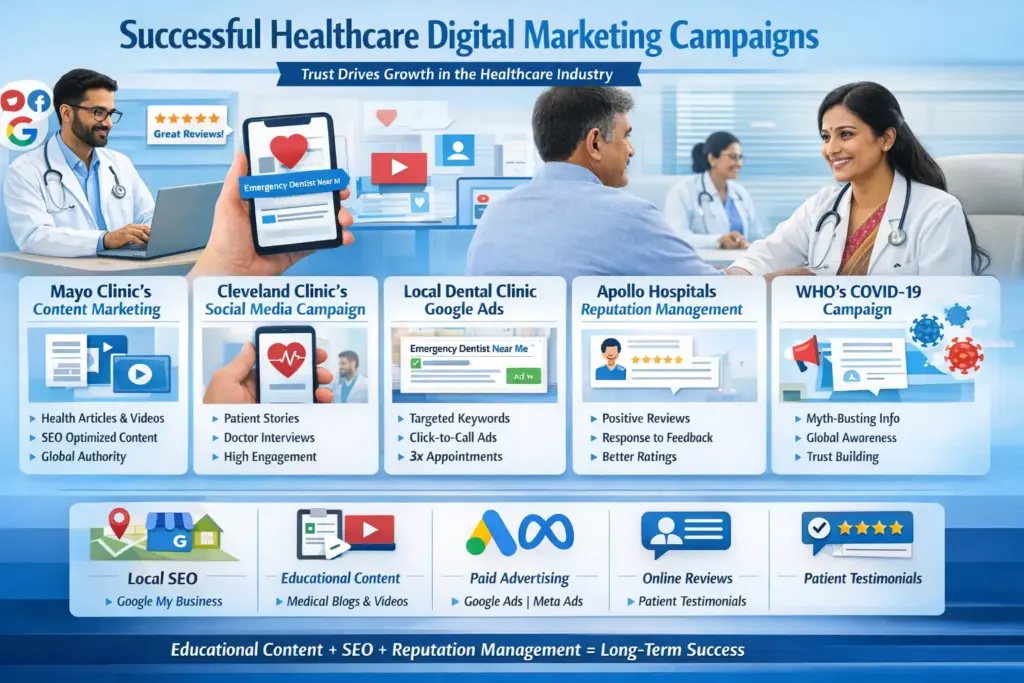
Social media awareness campaigns, patient testimonial video marketing, search engine optimization (SEO) for local clinics, Google Ads for making appointments, and reputation management tactics are all examples of effective digital marketing campaigns in the healthcare field. Hospitals and clinics who use content marketing, paid advertising, local SEO, and ways to develop trust all see a steady rise in patient interaction, online exposure, and appointment reservations.
Introduction: Why Healthcare Digital Marketing Matters
Over the past ten years, healthcare has seen significant change. Referrals are no longer the exclusive option for patients. Instead, before scheduling an appointment, they look up hospitals, read reviews, check social media, and conduct a Google search.
Healthcare businesses need to establish digital trust as a result of this change. Campaigns that are successful do more than just advertise services. They build credibility, educate patients, and address actual issues.
Let’s now look at actual instances of healthcare digital marketing efforts that have been successful and analyze what made them so.
1. Mayo Clinic’s Content Marketing Strategy
Entity: Mayo Clinic
Mayo Clinic is widely recognized for its powerful content marketing approach. Instead of focusing only on promotions, it publishes high quality educational articles, blogs, and medical videos.
What They Did:
- Developed health guidelines that work for SEO
- Published blogs written by experts
- Content for shared disease awareness
- Created educational videos for patients.
Why It Worked:
First, the content answered real patient questions. Second, the information was backed by medical professionals, strengthening EEAT (Experience, Expertise, Authoritativeness, Trustworthiness). Finally, the content ranked on Google for thousands of health related keywords.
Result:
Massive organic traffic
Global brand authority
Increased patient trust
Key takeaway: Educational SEO content builds long term authority.
2. Cleveland Clinic’s Social Media Campaign
Entity: Cleveland Clinic
Cleveland Clinic used emotional storytelling on platforms like Facebook and YouTube.
Campaign Strategy:
Shared patient recovery stories
Posted doctor interviews
Highlighted behind the scenes hospital care
Unlike traditional hospital advertisements, these posts focused on human connection.
Why It Worked:
People relate to real stories. Therefore, engagement increased naturally. In addition, video content improved reach and shares.
Result:
Higher engagement rates
Strong brand reputation
Increased patient inquiries
Key takeaway: Emotional storytelling builds deeper patient relationships.
3. Google Ads Campaign for Local Dental Clinic
Let’s look at a practical small scale example.
A local dental clinic ran Google Ads targeting “emergency dentist near me.”
Strategy:
Used location-based keywords
Optimized landing pages
Added click to call buttons
Enabled Google Business Profile
Why It Worked:
When patients search for emergency services, they need immediate solutions. Therefore, highintent keywords converted quickly.
Result:
3x increase in appointment bookings
Lower cost per acquisition
Higher ROI
Key takeaway: High-intent PPC campaigns generate fast results.
4. Apollo Hospitals Reputation Management Strategy
Entity: Apollo Hospitals
Apollo Hospitals strengthened its online reputation through review management.
Campaign Actions:
Encouraged satisfied patients to leave reviews
Responded professionally to negative feedback
Optimized Google Business Profile listings
Because healthcare decisions depend heavily on trust, reviews directly influence bookings.
Result:
Improved average ratings
Better local search visibility
Increased patient confidence
Key takeaway: Online reputation is a powerful growth engine.
5. COVID-19 Awareness Campaign by WHO
Entity: World Health Organization (WHO)
The WHO launched digital campaigns across social media platforms during the COVID-19 pandemic.
Strategy:
Myth-busting content
Shareable infographics
Multilingual video messages
Collaboration with platforms like Facebook and Twitter
Why It Worked:
Accurate information reduced misinformation. Moreover, consistent branding improved credibility.
Result:
Massive global reach
Public health awareness
Trust reinforcement
Key takeaway: Clear messaging and authority create impact at scale.
Core Elements Behind Successful Healthcare Digital Marketing Campaigns
Although each campaign differs, certain elements remain consistent.
1. Strong Local SEO
Optimized Google Business Profile
Local keyword targeting
NAP consistency
2. Educational Content Marketing
Blog articles
Explainer videos
Downloadable guides
3. Paid Advertising
Google Ads
Meta Ads
Retargeting campaigns
4. Social Proof
Patient testimonials
Before-and-after stories
Online reviews
5. Data Analytics
Google Analytics
Conversion tracking
Campaign ROI monitoring
Successful campaigns integrate multiple channels instead of relying on a single tactic.
EEAT Optimization in Healthcare Campaigns
Healthcare falls under YMYL (Your Money or Your Life) content. Therefore, Google requires high levels of trust.
To improve EEAT:
Mention licensed doctors as authors
Include medical credentials
Add citations from reputable institutions
Maintain transparent contact details
Update content regularly
Trust signals directly impact rankings and conversions.
Semantic SEO for Healthcare Marketing
Modern SEO focuses on context rather than single keywords.
For example, instead of targeting only “hospital marketing,” successful pages include related entities such as:
Patient acquisition
Telemedicine
Electronic Health Records (EHR)
HIPAA compliance
Appointment scheduling software
Medical SEO
Healthcare PPC
This semantic structure improves topical authority.
Measurable Results from Healthcare Digital Campaigns
Successful healthcare marketing campaigns typically improve:
Organic traffic
Appointment bookings
Cost per lead
Patient lifetime value
Brand recognition
However, results depend on strategy consistency and budget allocation.
FAQs: Examples of Successful Healthcare Digital Marketing Campaigns
1. What makes a healthcare digital marketing campaign successful?
A successful campaign builds trust, provides accurate information, uses SEO effectively, and encourages patient engagement across multiple channels.
2. Which platform works best for healthcare marketing?
Google Search works best for high-intent queries. Meanwhile, Facebook and Instagram perform well for awareness and storytelling.
3. How important are patient reviews?
Patient reviews significantly influence healthcare decisions. Higher ratings improve local SEO and increase appointment bookings.
4. Can small clinics run successful digital campaigns?
Yes. With local SEO, targeted Google Ads, and proper review management, small clinics can compete effectively.
5. Is content marketing effective in healthcare?
Educational content builds authority and improves search visibility. Over time, it becomes a sustainable patient acquisition strategy.
Conclusion
Examples of successful healthcare digital marketing campaigns show one clear pattern: trust drives growth. Educational content, local SEO, paid advertising, and reputation management work best when combined strategically.
Hospitals and clinics that prioritize patient education, transparency, and digital visibility consistently outperform competitors. Therefore, healthcare providers must invest in long-term digital strategies rather than short-term promotions.
If executed correctly, digital marketing does not just generate appointments. It builds credibility, loyalty, and sustainable brand authority.