
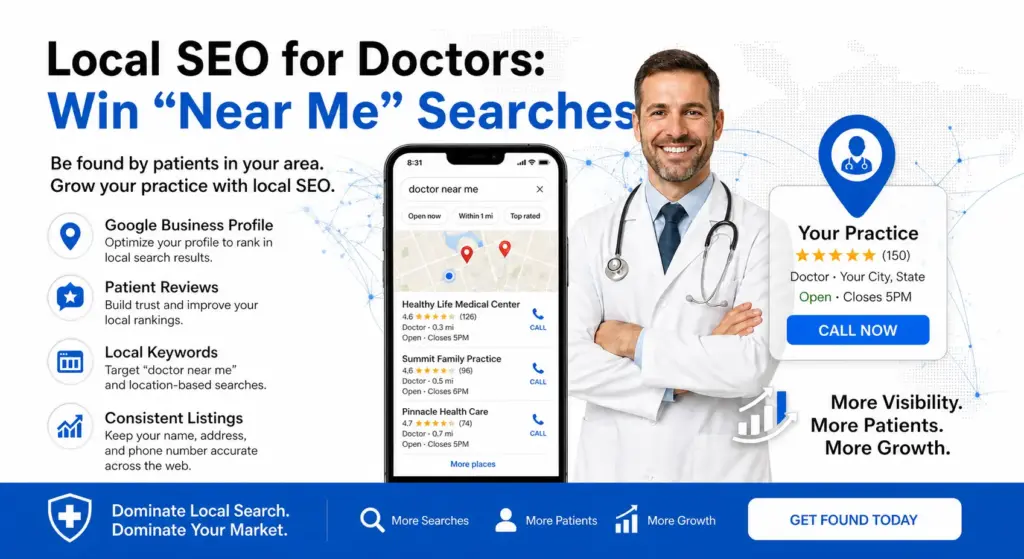
Doctor near me.” “Pediatrician near me.” “Urgent care near me.” These simple three-word searches represent some of the most valuable queries in healthcare marketing. When someone searches for medical care using “near me,” they’re not casually browsing. They need a doctor now, and they’re ready to book an appointment with the first qualified provider they find.
The question is: will they find you?
Local SEO for doctors determines whether your practice appears in these high-intent searches or remains invisible while competitors capture these ready-to-book patients. With 77% of patients using search engines before booking appointments and “near me” searches growing by over 200% in recent years, local search optimization isn’t optional. It’s essential for practice growth.
At DigifyClinic, we specialize in helping doctors and healthcare brands dominate local search results. Our healthcare-focused expertise ensures you appear exactly when and where patients are searching for the services you provide.
This guide reveals the strategies that win “near me” searches and transform local visibility into consistent patient acquisition.
Understanding Local SEO for Healthcare
What Makes Local SEO Different
Local SEO for doctors differs fundamentally from general search engine optimization. While traditional SEO aims to rank for broad searches nationally or globally, local SEO focuses on geographic-specific queries where proximity and relevance determine rankings.
When patients search “cardiologist near me” or “family doctor in Boston,” Google doesn’t simply show the most authoritative cardiology websites. It shows nearby practices that match the searcher’s location and intent.
Google’s local algorithm considers three primary factors:
Relevance: How well does your practice match what the searcher wants? Your specialty, services, and business category determine relevance.
Distance: How close is your practice to the searcher’s location? Google determines this through the searcher’s device location or search terms, including location names.
Prominence: How well-known and reputable is your practice? Reviews, citations, links, and your overall online presence influence prominence.
Success in local SEO for doctors requires optimizing all three factors simultaneously.
The Local Pack: Prime Real Estate
When someone performs a local search, Google displays the “local pack,” three business listings with maps, ratings, and key information appearing above traditional organic results.
These three positions capture the majority of clicks. Studies show that 44% of local searches result in clicks on local pack listings, while only 15% click through to organic results below.
Getting into the local pack dramatically increases visibility and patient acquisition. This is where local SEO for doctors delivers the highest ROI; these prominent positions drive phone calls, direction requests, and appointment bookings.
Google Business Profile: Your Local SEO Foundation
Your Google Business Profile represents the single most important factor in local search rankings. A fully optimized profile is essential for local SEO for doctors.
Complete Every Profile Section
Google rewards complete profiles with better rankings. Many doctors create basic listings but leave critical sections empty, a costly mistake.
Must-complete sections:
- Business name (your practice’s actual legal name)
- Category (primary: your specialty; secondary: additional services)
- Address (must match exactly across all online mentions)
- Phone number (local number, not toll-free)
- Website URL
- Hours of operation (including special hours)
- Business description (750 characters explaining your practice)
- Services list (every service you offer)
- Attributes (wheelchair accessible, accepts new patients, etc.)
Incomplete profiles rank lower and convert worse. Patients need complete information to choose your practice confidently.
Strategic Category Selection
Your primary category profoundly impacts which searches display your profile. Choose the most specific category accurately describing your practice.
General categories like “Doctor” or “Medical clinic” face intense competition. Specific categories like “Pediatrician,” “Dermatologist,” or “Orthopedic surgeon” target more qualified searches with less competition.
You can add secondary categories for additional services, but your primary category should reflect your core specialty and the searches you most want to win.
Reviews: The Trust and Ranking Factor
Patient reviews influence both your ranking position and whether searchers choose your practice over competitors.
Google’s algorithm considers:
- Review quantity: More reviews signal an established, popular practice
- Review recency: Recent reviews matter more than old ones
- Review rating: Higher average ratings improve rankings
- Review keywords: Google reads review content for relevance signals
Focus on generating consistent reviews monthly. A practice with 150+ reviews and a 4.7-star average will typically outrank competitors with fewer reviews, even if those competitors have perfect 5.0 ratings.
Implement systematic review requests:
- Ask satisfied patients to share their experience
- Send email or text requests 2-3 days post-appointment
- Make it easy with direct review links
- Respond professionally to all reviews, positive and negative
DigifyClinic helps medical practices implement compliant, effective review generation systems that steadily build their reputation and local search rankings.
Regular Posts and Updates
Google Posts allow you to share timely updates directly on your Business Profile. Regular posting signals an active, engaged practice, a positive ranking factor.
Post 2-3 times weekly with:
- Health tips and seasonal advice
- New services or providers
- Office hours changes
- Community involvement
- Educational content
Posts remain visible for seven days, then archive. Consistent posting keeps your profile fresh and engaging.
Website Optimization for Local Search
Your website works in tandem with your Google Business Profile to dominate local SEO for doctors. Strategic website optimization reinforces your local relevance.
Local Keyword Integration
Incorporate location-based keywords naturally throughout your website:
- Homepage: “Board-certified pediatrician in downtown Seattle.”
- Service pages: “Sports physicals for Bellevue students.”
- About page: “Serving the Greater Portland area since 2010.”
- Blog posts: “Managing seasonal allergies in the Pacific Northwest.”
Avoid keyword stuffing, write naturally for human readers while including location terms where genuinely relevant.
Dedicated Location Pages
Multi-location practices should create unique pages for each office. Even single-location practices benefit from a dedicated location page featuring:
- Complete address and embedded Google map
- Office photos
- Parking and transportation information
- Hours of operation
- Staff at this location
- Services offered here
- Directions from nearby landmarks
Location pages target searches including your city, neighborhood, or region names.
Mobile Optimization is Critical
Seventy percent of “near me” searches occur on mobile devices. If your website loads slowly or displays poorly on smartphones, you’ll lose these high-intent visitors immediately.
Mobile optimization requirements:
- Responsive design that adapts to screen sizes
- Fast loading speed (under 3 seconds)
- Click-to-call phone numbers
- Easy-to-tap buttons
- Legible text without zooming
- Simplified navigation
Google prioritizes mobile-friendly sites in local search results. Mobile optimization directly impacts your local SEO for doctors’ performance.
Local Business Schema Markup
Schema markup is code that helps search engines understand your website content. Local business schema tells Google specific details about your practice:
- Business type (medical practice, specific specialty)
- Name, address, phone number
- Hours of operation
- Accepted payment methods
- Service areas
- Reviews and ratings
While schema doesn’t directly boost rankings, it helps Google display rich results with enhanced information, improving click-through rates and visibility.
Building Local Citations and Listings
Citations are online mentions of your practice name, address, and phone number (NAP). They validate your business information and strengthen local SEO for doctors.
NAP Consistency is Essential
Your practice name, address, and phone number must appear identically across every online mention. Inconsistencies confuse Google and hurt rankings.
Common consistency problems:
- Different phone numbers on different sites
- Address abbreviations vary (Street vs. St., Suite vs. Ste.)
- Business name variations (including or excluding LLC, MD, etc.)
Create a master reference document with your exact NAP formatting, then ensure every listing matches precisely.
Healthcare-Specific Directories
Beyond general directories like Yelp and Yellow Pages, list your practice on healthcare-specific platforms:
Essential healthcare directories:
- Healthgrades
- Vitals
- WebMD Physician Directory
- Zocdoc
- RateMDs
- Sharecare
- Wellness.com
Insurance provider directories:
List every insurance plan you accept. These directories receive high traffic from patients searching for in-network providers.
Local directories:
- Chamber of Commerce
- Local business associations
- Community health resources
- Hospital physician referral services
Managing Your Listings
Claim and verify your listings on major platforms, then:
- Complete every available field
- Add photos where possible
- Monitor for reviews and respond
- Update information when changes occur
- Correct inaccurate listings you didn’t create
Inconsistent or outdated listings damage your local SEO for doctors’ efforts and frustrate potential patients who encounter wrong information.
Reviews and Reputation Management
Online reputation directly impacts local search rankings and patient decision-making. Strategic reputation management is crucial for local SEO for doctors.
Multi-Platform Review Strategy
While Google reviews matter most for local SEO, patients research across multiple platforms. Build reviews on:
Priority platforms:
- Google (highest SEO impact)
- Facebook (widely trusted, high visibility)
- Healthgrades (healthcare-specific authority)
Secondary platforms:
- Yelp (despite its relationship with Google) influences patients)
- Vitals (healthcare credibility)
- RateMDs (specialty-specific)
Don’t spread efforts too thin; focus on 2-3 primary platforms where your target patients search.
Responding to Reviews Builds Trust
Review responses demonstrate engagement and care. Respond to positive reviews with brief thanks, and address negative reviews professionally.
Response best practices:
For positive reviews:
- Thank the reviewer by name
- Acknowledge specific compliments
- Reinforce commitment to quality care
- Keep it brief and genuine
For negative reviews:
- Respond within 24-48 hours
- Acknowledge concerns without admitting fault
- Invite offline conversation
- Never violate HIPAA by discussing their care
- Stay professional regardless of tone
Other potential patients read your responses. They’re evaluating not just your reviews but how you handle feedback.
The Review Velocity Factor
Google considers review frequency in rankings. Practices generating steady, consistent reviews perform better than those with sporadic bursts.
Aim for systematic review generation:
- Set monthly review goals
- Train staff to request reviews appropriately
- Automate post-appointment review requests
- Make the process easy with direct links
Even 5-10 new reviews monthly significantly strengthen your local SEO for doctors’ positioning over time.
Content Marketing for Local SEO
Strategic content creation reinforces local relevance while providing value to your community.
Local Content Ideas
Create blog content addressing local health concerns and community interests:
- Seasonal health topics relevant to your climate
- Coverage of local health events or initiatives
- Guides to health resources in your area
- Neighborhood-specific advice (“Best walking trails in [city] for exercise”)
- Local health statistics and trends
This content targets long-tail local searches while establishing a community connection.
Community Involvement Creates Links and Mentions
Participate in local events, sponsor community organizations, and engage with local causes. These activities generate:
- Local media coverage and links
- Mentions on community websites
- Social media engagement
- Brand awareness in your community
Google recognizes these local signals, strengthening your prominence in local SEO for doctors’ rankings.
Patient Education Content
Educational content serves dual purposes, helping patients while targeting relevant searches:
- Condition explanations with local context
- Procedure guides
- Pre/post-appointment information
- FAQ pages addressing common concerns
- Preventive care guides
Optimize this content with location modifiers where natural: “Preparing for allergy season in [city]” or “Choosing a pediatrician in [neighborhood].”
Conclusion: Dominate Your Local Market
Local SEO for doctors transforms how patients discover your practice. When you consistently appear in “near me” searches and the Google local pack, you capture high-intent patients at the exact moment they’re seeking care.
The strategies in this guide optimized Google Business Profile, strategic website optimization, consistent citations, active reputation management, and local content creation work together to establish dominant local visibility.
Implementation requires initial effort and ongoing maintenance, but the results justify the investment. Practices winning local search enjoy:
- Consistent new patient acquisition
- Higher-quality leads (local patients with immediate needs)
- Reduced marketing costs (organic visibility vs. paid advertising)
- Competitive advantage over less-optimized practices
Start with Google Business Profile optimization and review generation, which deliver the fastest results. Then systematically address other factors to build comprehensive local search dominance.
Partner with Local SEO Experts for Healthcare
While these strategies are clear, effective execution requires expertise, time, and consistent effort. That’s where DigifyClinic delivers exceptional value.
We specialize exclusively in local SEO for doctors and healthcare brands. Our team understands medical practice marketing, healthcare compliance, and the unique challenges physicians face in local search.
Our local SEO services include:
- Complete Google Business Profile optimization
- Review generation and reputation management
- Local citation building and management
- Website optimization for local search
- Content creation targeting local searches
- Ongoing monitoring and optimization
- Comprehensive reporting on rankings and patient acquisition
We don’t just improve your rankings, we drive measurable patient growth through strategic local SEO for doctors.
Ready to win the “near me” searches in your market? Contact DigifyClinic today for a free local SEO audit. We’ll analyze your current visibility, identify opportunities, and show you exactly how we’d establish your practice as the top local choice.
Let’s transform local search from a mystery into your most reliable patient acquisition channel.