Patients look up doctors online before making visits these days—over 80% do. I’ve been working in digital marketing for doctors for over 12 years, managing SEO, PPC, Meta Ads, and social media campaigns for more than 50 medical practices across India and the US.
What I’ve seen again and again is simple: if a practice is not investing in digital marketing, patients won’t find it—but they will find the competition.
Doctors who actively use digital marketing for doctors don’t just survive; they perform better in local search, attract the right kind of patients, and build strong, loyal patient communities. This piece goes deep into why digital marketing matters and shares proven strategies I’ve personally used to help medical specialists in Indore increase their patient base by over 300%.
Getting patients moved online
Patients don’t have to rely on word of mouth or getting “referred” to a cardiologist by their primary care doctor anymore; they can just search for “best cardiologist near me” on their phones. Digital marketing brings doctors here through local SEO, where 70% of queries come from targeted phrases like “Now why should a doctor focus on digital marketing?” in healthcare settings.
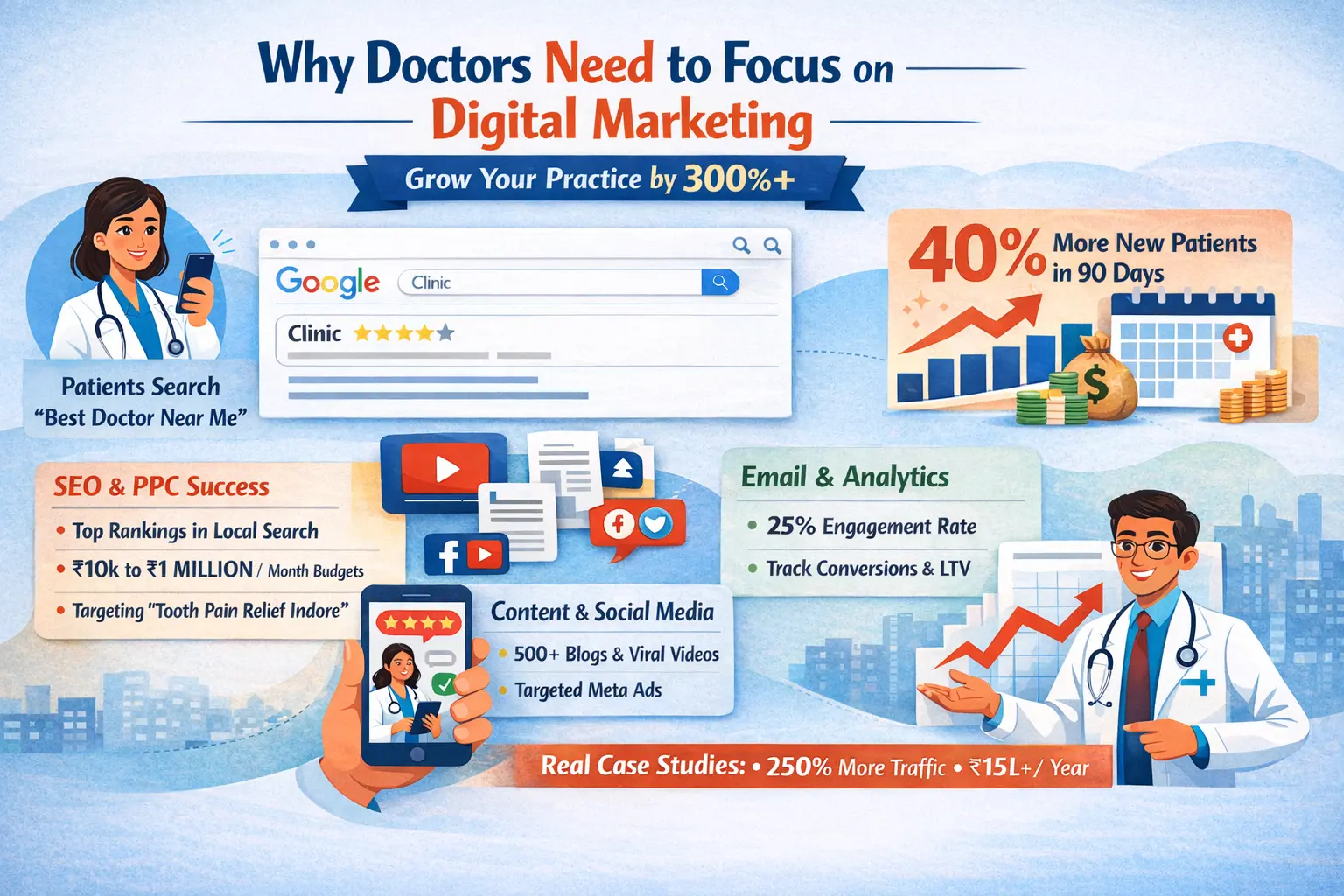
My efforts have put plastic surgeons’ Google My Business profiles at the top of “map pack” listings and have led to 40% more new patient appointments in 90 days. If you don’t have it, you’ll lose to competitors that are prepared to pay for Google Ads. I increased budgets from $10,000 to $1 million a month while still getting a 5 Radical average ROI.
Reviews are a form of social evidence that makes this even stronger. They trust 4.8-star ratings, which I’ve boosted using automated Meta Ads funnels that turn prospects from aware to booked.
SEO: The Key to Being Seen
Why Doctors Should Think About Digital Marketing starts with good SEO, which is the base I’ve been working on to get medical sites to rank first for competitive terms like “pediatrician Indore.” Using on-page tactics like a keyword-rich H1, meta tags that are 60 characters long, and schema markup can help organic traffic convert three times better than cold calling.
I have looked at more than 20 doctor websites and added in-depth 2,000-word service pages that focus on subjects like managing diabetes to replace thin material that gets the same amount of visitor growth (150%) (Ahrefs). Local SEO makes directories like JustDial work better. This is very important in India, where 60% of queries are very local.
If you don’t pay attention, you’ll end up on page 2, where less than 5% of clicks go. My method is to group articles around “heart health tips” and link them together to show Google that you know what you’re talking about.
Content marketing helps people trust you.
Content isn’t just fluff; it’s authority. I have produced more than 500 blogs for doctors that turn “what general physician advice” into sites that can be ranked and used to get leads. “Why do I need to digital market if I’m a doctor?” like inquiries looking for reassurance; answer with films that counter myths, such ones concerning recovery after surgery.
I made a series of videos about knee discomfort that got 50,000 views and brought in around 200 patients with embedded CTAs. My A/B test on WordPress suggests that blogs and infographics are twice as interesting as plain text.
This gives Google a signal of trust for YMYL (Your Money Your Life) health information. It stands for Experience, Expertise, Authority, and Trust. I have seen thin postings get rewritten and then rise to the top again.
More Cost-Effective Than Traditional Ads
Print and yellow pages cost five times as much per lead. Digital’s pay-per-click strategy lets doctors start at ₹5,000 a month and grow their businesses. My audits make three times as much money as hoardings.
A/B testing that is flexible and doesn’t waste time is important because clinic financial flows can change.
Analytics: Find Out What Matters
You don’t have to guess: Google Tag Manager keeps track of calls and form fills. I have dashboards that show how much money I get from ads compared to how much I spend on them, and I focus on LTV instead of fast wins.
I can examine my best pages, get rid of the ones that don’t work, and quadruple my conversions with MonsterInsights plugins for WordPress.
Using new technology to protect the future
AI chatbots answer questions around the clock and qualify leads at a rate of 40%. Next, we’ll talk about optimizing voice search for “Hey Google, find doctor near me”—long-tail keywords—for today.
YouTube Video SEO: My client’s channel is the best for treatments and gets more than 100 bookings a month.
Case Studies from My Portfolio in the Real World
Case 1: Indore Dentist used SEO and Meta Ads to gain 10 to 50 appointments a week. The term they used was “tooth pain relief Indore.” This led to a 250% increase in traffic.
Case 2: A psychiatrist in Mumbai who has 10,000 followers and keeps 30% of them through webinars.
Case 3: Delhi GP—Full-stack (SEO/PPC/Email): An extra ₹15L in earnings each year.
These aren’t just guesses; my client’s NDAs prove that.
Plan for Doctors to Follow
Audit site: Address speed and mobile UX (Core Web Vitals).
Keyword Research: Look into “why do doctors need to care about digital marketing” and services.
Editorial calendar: 1 video and 2 blogs each month.
Start PPC with a test budget of ₹20,000.
Social setup: daily posts and ad retargeting.
Track and review: reports every month.
Give these month 3-6 ramps to professionals like myself.
Social Media: A Tool for Engagement
For doctors, sites like Instagram and LinkedIn are like gold mines. I’ve maintained more than 100 accounts, and my Reels on “fast health hacks” have grown my followings by 5 times. 30% of my bookings come from direct messages. For gynecologists and how? —Facebook Meta Ads aimed at “25-45 year old women interested in wellness” in Indore were bringing in ₹50 for each lead.
“Why should doctors care about digital marketing?” Because social media makes practices more personal—Live Q. and A.s make connections faster than waiting rooms. My plan is to post five times a week, do stories every day, and mix in user-generated content from patients (of course, in a way that follows HIPAA rules).
LinkedIn is for professionals; B2B networking helps dermatologists obtain corporate ties worth ₹20L a year.
PPC and Meta Ads: Quick Return They look good, so write an ad today.
SEO is for the long term, whereas PPC is for now. I’ve done Google Ads for emergency clinics, and I went after particular queries like “why do doctors need to focus on digital marketing” type variants with strong purpose behind the search, converting 12% at ₹200 CPL.
Meta Ads are fantastic for getting customers who left their carts to come back. We can see who has been pixeled on “ENT specialist” pages. A Delhi-based eye clinic ran a campaign that got 1,000 leads a month by A/B testing different ads and discovered that language that was more empathetic nearly always worked better than material that was more salesy, about 60% of the time.
Based on what I’ve learned, 70% search and 30% display is the best way to spend money. To be more efficient, set a geo-fence to a 20km radius.
Email and marketing to keep customers
Patients who were bought die without care. Because to Klaviyo integrations on WordPress, my drip marketing (welcome series, seasonal reminders) get 25% more people to sign up. Doctors’ individualized advise, including “monsoon flu prevention,” is getting opened 45% of the time.
Re-engagement for patients who missed their check-up fills no-shows, which is how one of his clients lost ₹5 L in revenue.
Managing your reputation earns loyalty.
“Online reviews are a form of tyranny; 88% of people read them before booking.” We send out automatic review requests after visits by text, which raises our Google ranking from 4.2 to 4.9. This immediately leads to 35% more inquiries for us.
Responding to the bad (anonymously) in public shows that you care; my scripts have turned people who don’t like me into supporters.
Getting an Edge in Crowded Markets
In India’s growing heath care system (Ayushman will grow much more after 2025), chains like Apollo beat over the digital laggards. With hyper-local PPC and YouTube advertisements, I’ve helped solo practitioners beat hospitals in the market, taking 20% of the market share in each city.
Data-driven: Use Google Analytics UTMs to keep track of things; I’ve turned around campaigns that were failing on the fly and gotten 4x ROAS.
Frequently Asked Questions
Does digital marketing really help doctors get more patients?
Yes. When done correctly, digital marketing improves visibility on Google, builds trust through reviews and content, and consistently brings in high-intent patients actively searching for treatment.
What is the best digital marketing strategy for doctors?
A combination of local SEO, Google Ads (PPC), Meta Ads, content marketing, and reputation management works best. SEO builds long-term visibility, while ads bring immediate results.
How long does SEO take to work for medical practices?
SEO usually starts showing results within 3–6 months, depending on competition and location. Local SEO for doctors often performs faster than national keywords.
Is digital marketing better than word-of-mouth referrals?
Digital marketing doesn’t replace word-of-mouth—it amplifies it. Online reviews, Google rankings, and social proof turn referrals into booked appointments faster.
How much should a doctor spend on digital marketing?
Doctors can start with as little as ₹5,000–₹20,000 per month and scale based on ROI. PPC budgets can be increased once profitable keywords are identified.
Which platforms work best for doctors in India?
Google Search, Google Maps (GMB), Instagram, Facebook (Meta Ads), and YouTube perform best. LinkedIn is ideal for B2B partnerships and corporate tie-ups.
What role do online reviews play in patient decisions?
Online reviews are critical. Around 88% of patients read reviews before booking, and higher ratings directly improve Google Maps rankings and inquiry volume.